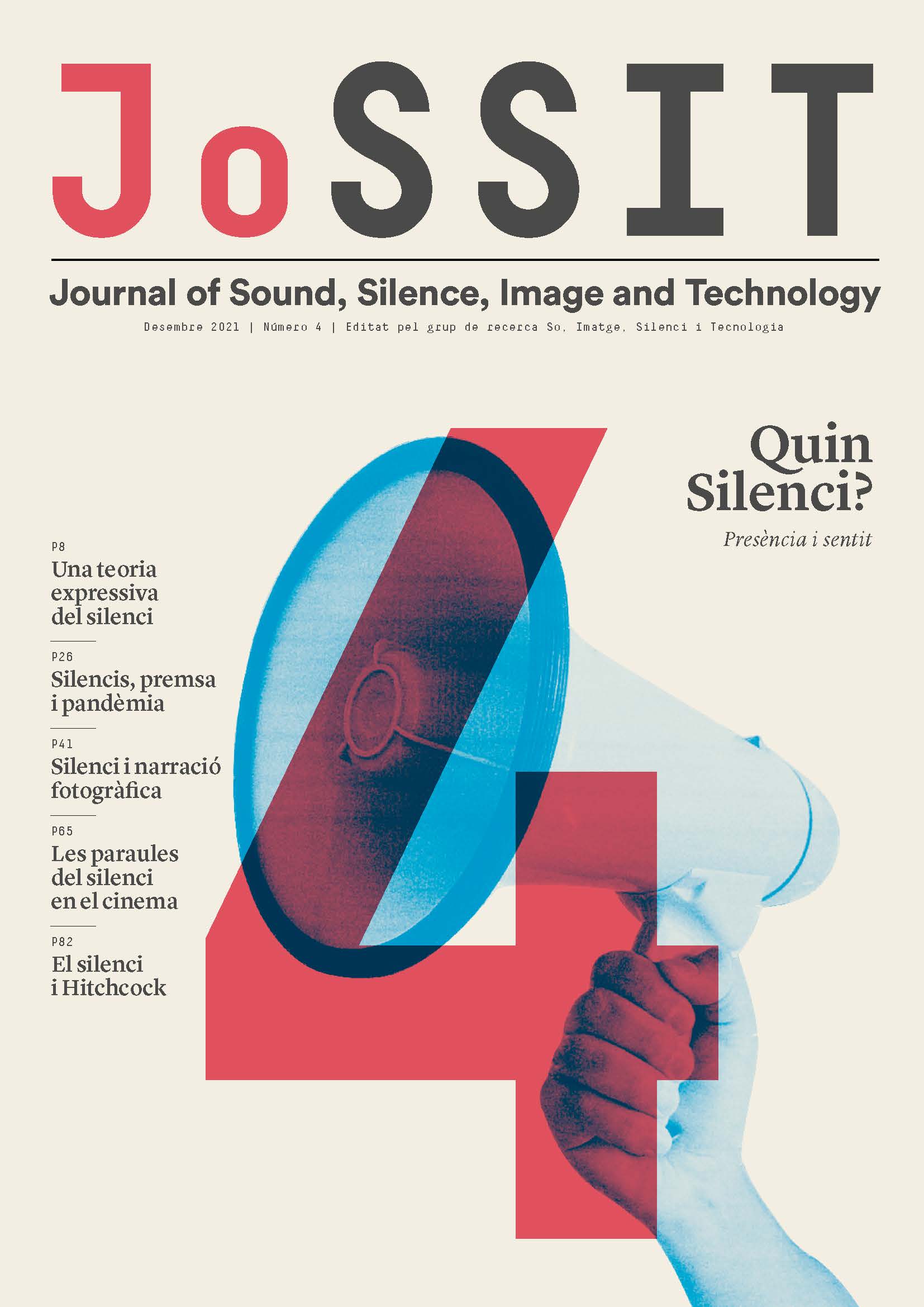
Silence in the language of Hitchcock’s cinema: the eloquence of silence
Keywords:
Silence, Hitchcock, Filmography, Symbolic Universe, film languageAbstract
The purpose of this article is to highlight the importance of silence in Alfred J. Hitchcock’s cinematic language, it being a fundamental element in order to address and understand the complexity of the symbolic universe of the British filmmaker. That silence, understood in its ambivalence and as a linguistic and communicative phenomenon on the one hand, and a matrix of non-verbal language in particular and of semiotics in general on the other, while not forgetting its presence in the structure of the narrative fabric, is essential in the master’s style. This style is inscribed in the “aesthetics of silence” in a very personal way that characterizes the artistic language of the twentieth century.
Published
Versions
- 2022-04-21 (2)
- 2021-12-22 (1)
How to Cite
Issue
Section
License
Copyright (c) 2021 Ángeles Marco Furrasola

This work is licensed under a Creative Commons Attribution 4.0 International License.
All articles and content published in the Journal of Sound, Silence, Image and Technology (JoSSIT) have an Attribution 4.0 International Creative Commons licence. More information can be found here: https://creativecommons.org/licenses/by/4.0/deed.en. This licence allows copying, distribution, public communication, derived works and commercial uses of JoSSIT content as long as the source (JoSSIT) and author of the article are credited.
For images, however, authors are solely responsible for obtaining the necessary permissions for any images used in their works that have copyright.
For any other use or permission not included here, please email the journal at: jossit@tecnocampus.cat
Unless otherwise indicated, at the time of submission authors will be deemed to accept JoSSIT's confidentiality policy and legal notice.
By submitting an article, the author accepts and declares that they are the original author of the work and that they have the necessary permissions, as well as accepting they are not performing any illegal act by submitting their work. The editor, director and members of JoSSIT are exempt from any obligation or responsibility arising from the work that may infringe the rights of third parties in any way.